Federal recycling and recycled content legislative update
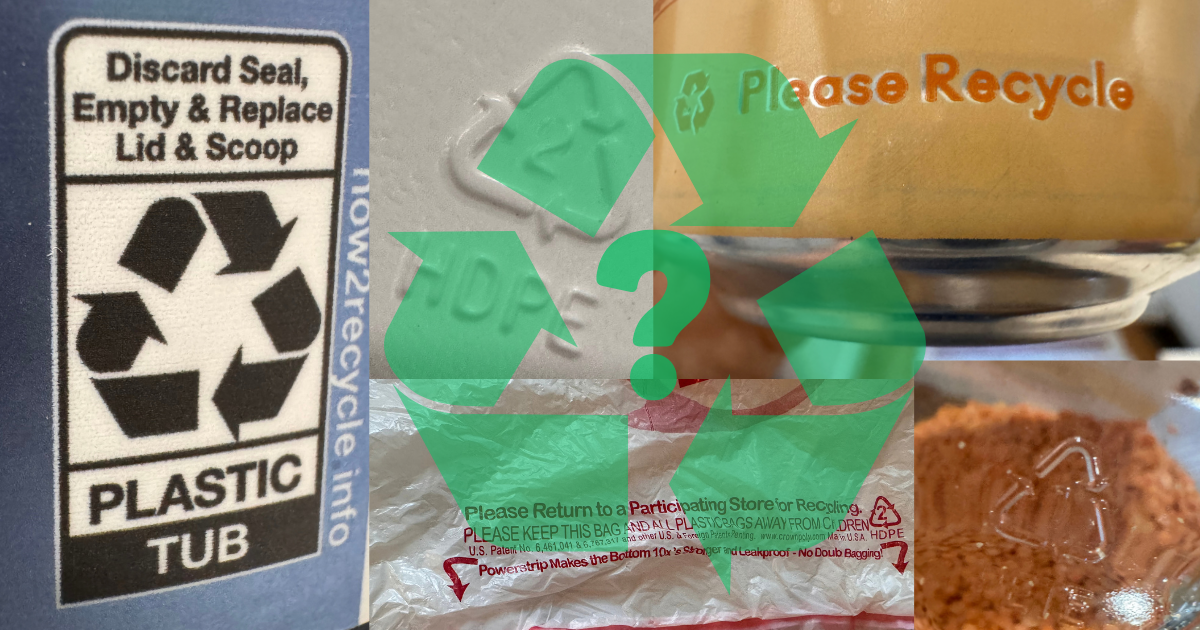
Examples of consumer packaging with different recycling “chasing arrows,” including a plastic tub, HDPE #2 hard plastic and flexible film, PET #1 plastic tub, and beverage can.
Confused about recycling arrows and what they mean? Do you sometimes wonder if product packaging is recyclable in your curbside recycling program or at all? In the last year, Congress has introduced a handful of new bills aimed at tracking recycled plastic materials and standardizing recycled content labeling requirements. Here is a brief overview of some of those competing bills. We’re tracking this legislation and how it might impact Maryland. We think recycled content and recyclability claims should be transparent and based on real world conditions accessible to consumers. Labels should be accurate and helpful to real people. Labels should not rely on technical accounting methods that are so complicated that they might mislead consumers about an item’s actual recyclability or recycled content.
Tracking Plastic Act of 2026 - Sen. Adam Schiff, D-California, introduced the Tracking Plastic Act to standardize the process of tracking recycled materials, address mislabeling, reduce fraud and errors, and verify origins of recycled plastic to enable Americans to better know the environmental impacts from products they purchase, according to a statement from his office. The legislation would establish a federal working group to make recommendations to improve measurement and reporting of recycled plastic content, including seeking harmonization with trading partners and helping to harmonize state recycled plastic tracking requirements, and enabling consumers to better understand the claims on the products they purchase. Supporters of the bill include the Association of Plastic Recyclers, World Wildlife Fund, Ocean Conservancy, Monterey Bay Aquarium, and the Recycling Partnership.
Recycled Materials Attribution Act of 2026 - Rep. Nicholas Langworthy, R-New York, introduced the Recycled Materials Attribution Act (RMAA) of 2026 to establish federal standards for recycling and recycled content marketing claims. The RMAA is supported by the Recycling Leadership Council, an industry coalition led by the Consumer Brands Association and including members from American Chemistry Council, Plastics Industry Association, Retail Leaders Industry Association, Ag Containers Recycling Council, and other industries. Supporters say that the RMAA would help spur investment in “advanced recycling” methods and bring federal recognition of mass balance for recycled and alternative feedstocks. Opponents, including the Natural Resources Defense Council and Moms Clean Air Force, argue that the RMAA would undermine consumer confidence by allowing confusing claims about recycled content based on deceptive accounting for recycled materials.
Truth in Labeling Act of 2026 - The Truth in Labeling Act, introduced by Rep. Correa (D-California) and Sen. Merkley (D-Oregon), aims to tackle confusion about the recycling “chasing arrows” symbol and what is really recyclable. The bill calls for creating an advisory committee and establishing updatable federal guidelines for labeling products as “recyclable”, “compostable”, “reusable”, or “refillable.” The bill includes criteria for avoiding inks and adhesive components that prevent recycling, using established covered material design guidelines (specific to each covered material industry — glass, steel, paper, plastic, fiber, etc.), and ensuring the covered materials have commercial value for recycling in a responsible end market. The bill would not preempt state laws so that state-specific environmental and recycling mandates would remain in effect alongside. Supporters of the bill include the Recycled Materials Association, US Composting Council, The Recycling Partnership, Upstream, Ocean Conservancy, and Just Zero.
Packaging and Claims Knowledge Act of 2025 (or “PACK Act”) - Introduced by Rep. Weber (R-Texas), the PACK Act establishes a federal framework for voluntary package labeling for recyclable, reusable, and compostable claims. It would preempt state packaging labeling laws. The bill was introduced with wide backing by consumer brands and packaging industry associations such as American Beverage Association, American Chemistry Council, Ameripen, Flexible Packaging Association, Carton Council, Can Manufacturers Institute, Biodegradable Products Institute, Nestle, Keurig DrPepper, and more.
The above federal bills are being considered in the shadow of California’s SB343, signed into law in 2021. SB343 is due to be implemented this October, although pending litigation and industry challenge may impact the timeline and outcome. SB343 prohibits the use of the recycling “chasing arrows” or other indicators of recyclability unless certain criteria are met. The intent is to help vendors and consumers make informed decisions about products, and to provide a basis for holding manufacturers responsible for misleading consumers about whether products gets recycled. The bill was championed by Californians Against Waste and the National Stewardship Action Council as a mechanism to increase transparency and align recyclability claims with real-world recycling programs and outcomes. The law was challenged by the Flexible Packaging Association and other business groups.